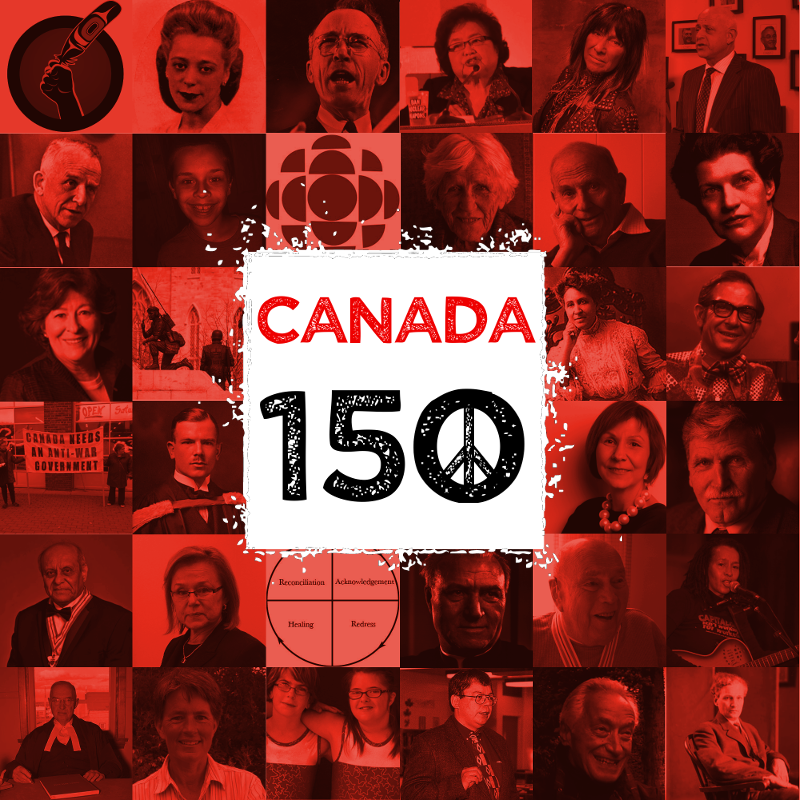
Viola Irene Desmond contributed to peace by fighting racial discrimination in Nova Scotia.#Canada150
Desmond was a Black Nova Scotian hairdresser who challenged racial segregation at a film theatre in New Glasgow, Nova Scotia in 1946. She refused to leave a whites-only area of the Roseland Theatre and was unjustly convicted of a minor tax violation used to enforce segregation. Her lawyer’s decision to opt for a judicial review rather than an appeal and to focus on her being wrongly accused of tax evasion was disastrous. The Justice hearing the case indicated that if it had been wrought by other methods the wrong she suffered might have been righted.
In 1954, segregation was legally ended in Nova Scotia. This case helped start the modern civil rights movement in Desmond’s case is one of the most publicized incidents of racial discrimination in Canadian history and helped start the modern civil rights movement in Canada. Desmond acted nine years before the famed incident by civil-rights activist Rosa Parks, with whom Desmond is often compared. Desmond was granted a posthumouspardon, the first to be granted in Canada. The government of Nova Scotia also apologized for convicting her for tax evasion and acknowledged she was rightfully resisting racial discrimination.
Idle No More contributes to peace by asserting Indigenous rights, Nation to Nation treaties, and protecting the land and water.#Canada150
The movement was initiated by activists Nina Wilson, Sheelah Mclean, Sylvia McAdam, and Jessica Gordon in November 2012, during a teach-in at Station 20 West in Saskatoon called “Idle No More”, held in response to the Harper Government’s introduction of Bill C-45 amending the navigable waterways act.
As a grass roots protest it has grown to focus on native sovereignty, the environment and the education and revitalization of indigenous peoples through awareness and empowerment. They specifically bring the viewpoint of aboriginal women to these issues.
Idle no more protesters marching along Government Street in Victoria, BC on December 21, 2012. Source: Wikipedia
Photo of Peacekeeper Memorial in Ottawa by Wikipedia contributor Andrijko Z.
UN Peacekeeping Operations contribute to peace through efforts to bring about an end to international conflicts around the world.#Canada150
United Nations Peacekeeping began in 1948 when the Security Council authorized the deployment of UN military observers to the Middle East. Since then, 69 peacekeeping operations have been deployed by the UN, 56 of them since 1988. Over the years, hundreds of thousands of military personnel, as well as tens of thousands of UN police and other civilians from more than 120 countries have participated in UN peacekeeping operations. More than 3,326 UN peacekeepers from some 120 countries have died while serving under the United Nations’ flag.
UN Peacekeepers provide security and the political and peacebuilding support to help countries make the difficult, early transition from conflict to peace. UN Peacekeeping is guided by three basic principles:
Consent of the parties;
Impartiality;
Non-use of force except in self-defence and defence of the mandate.
Humphrey was a principal drafter of the Universal Declaration of Human Rights. After consulting with the executive group of the Commission, chaired by Eleanor Roosevelt, Professor Humphrey prepared the first preliminary draft of what was to become the Universal Declaration of Human Rights. Mrs. Eleanor Roosevelt Referred to it as “the international Magna Carta of all humankind.”
During his career at The United Nations, Humphrey oversaw the implementation of 67 international conventions and the constitutions of dozens of countries. He worked in areas including freedom of the press, status of women, and racial discrimination. In 1988, on the 40th anniversary of the Declaration, the UN Human Rights Award was bestowed on Professor Humphrey.
In 1963, he put forth the idea of a United Nations High Commission for Human Rights. While the idea was initially received quite positively, it was only after more than thirty years, that the office became a reality.
As a diverse group of Canadians from every origin and walk of life, PeaceQuest members have been inspired by this historic moment to recognize the last 150 years of nation building. As much as this is surely a time to celebrate, it is also an occasion for conversation and introspection. What have been our aspirations as a nation? How are these hopes informed by our rich indigenous history which well pre-dates 1867? Is there a shared vision for the future?
PeaceQuest proposes that central to these celebrations and conversations around our national identity, the core value of peace enjoys an important and prominent place.
Follow us to stay on top of the names as they are announced!
The Canada 150 initiative will, for 150 days from February 2 to July 1, 2017, highlight a person, organization, event or artifact that has contributed to peace in our communities, our nation or, indeed, in our world. Through various social media, PeaceQuest will post these contributions daily so that we can all learn more about Canadian efforts, both historic and contemporary, to promote peace as a core Canadian value.
What do you mean by a contribution to peace?
This is an important question. Just as PeaceQuest has hesitated to offer a strict definition of peace, suggesting instead a description of peace (Peace is an active way of living, seeking to resolve conflicts cooperatively, respecting the wellbeing of the earth and all peoples.), so we wanted to leave this notion as broad as possible. We understand such contributions to exist across a spectrum, from explicit efforts to end violence, to initiatives that address the causes of violence, to more general work to advance and defend basic human dignity.
Who’s to say that PeaceQuest’s 150 selections are the right choices?
Good question. It’s not so much about getting it right, but more about fostering a broad conversation about peace. We anticipate that there will be some names that will surprise you, either by their presence or their absence. But that’s where Canadians can get involved and make this a national conversation. We need to hear other voices, your voice.
How can I participate?
There are two ways in which you can get involved:
1. offer your own feedback on what we post in the comments section below.
2. send us your own ideas by completing the following statement on the Contact Us page.
” _____________ , (insert name of a person, organization, event, artifact) contributed to peace by _________________________.”
In the first blank, identify a person, organization, event or artifact (it already may be well known across the county or, in your estimation, someone/thing that should be better known by Canadians). In the second blank, briefly describe how this person/organization/ event/artifact has helped to foster peace (in your community; across our nation; globally).
Is that all there is to it?
No, there is actually more. By following the links provided, you will be able to find more information on our web page about the item listed. Beyond that, it’s up to you to dig deeper.
And where you have offered your own contribution, why not consider including a more complete description of how this person/organization/ event/artifact contributed to our national character in terms of peace? If you have a suitable photo or graphic, we would love to see that, too.
Won’t there be more than 150 items if many others get involved?
We sure hope so … and PeaceQuest will continue to post and moderate this conversation up to the end of 2017.
Together, let us celebrate those who have insured that peace remains a core Canadian value lying at the heart of our collective Canadian identity.
Suggested ‘songs suitable for children’: identified by plus-sign + next to song title.
2 new publications (identified in italics in the list).
12 new songs (identified in italics in the songlist).
Highlights: 2 more Buffy Sainte-Marie songs; ‘Walking for peace’ by Attawapiskat Youth (Youtube); outstanding song & video by California rap guy, Matre, ‘Listen’ (Youtube)…
All the new songs have been added to the ‘Songs about peace and war’ playlist/channel on Youtube. It has good versions of all 160+ songs. Updated songs have needed to get inserted down toward the end of the playlist.
Wendy Luella Perkins is a Kingston singer-songwriter and music teacher. Here she is leading a song about peace, at a community sing-along organized by PeaceQuest-Kingston and Cantabile Choirs. It was held at Sydenham St. United Church in January, 2015. (Photo by Hilbert Buist.)Kingston’s Al Rankin — backed-up by Liam Fenton on guitar and vocals and Kieran L’abbe on 5-string banjo — performs John McCutcheon’s song, ‘Christmas in the Trenches’, at an event organized by PeaceQuest-Kingston to remember the Christmas truces of 1914. It was held at Memorial Hall in December, 2014. (Photo by Jolene Simko.)
Introduction
This is a list of more than 160 excellent songs about peace and war, plus eight published song collections. Some listed songs are recent songs, some are older (from the 1950’s, 60’s and 70’s), a few are traditional. Composers and dates of composition are listed for all the listed songs. (Canadian composers are identified in boldface.)
Music can make valuable contributions to peacework. Thankfully, it’s still happening — although not as regularly as during the ‘peace movements’ in North America and elsewhere during the Cold War. The list is intended to encourage and assist peace-workers to find ways to include music in their efforts.
People connect with music in ways they might not connect with other kinds of presentations. More than a few musicians who sing about peace and war have commented that music is heartfelt. It can also be incredibly thought-provoking — valuable in educational settings of all kinds, for learners of all ages. Plus of course: as a common language, music is entertaining.
Good versions of nearly all the songs listed here can be found by searching on Youtube. (And don’t forget the Youtube playlist/channel of all the songs: here.) As well, words for almost every song can be found by on-line searching: in your search-engine, write the song title and add the word, lyrics. Similarly, chords can be found by the same search method — adding chords to the song title.
The list is a work-in-progress. To get it to this point, many resources were consulted, as well as many people familiar with songs about peace and war. Certainly there are gaps: more songs are needed for primary/junior-age children; almost none on the current list have francophone composers; the majority of the songs were composed by white men from the English-speaking world. So if you check the list from time to time, you’ll find increased variety.
If you have songs and/or publications to suggest being added to the list, please do it — either in a ‘comment’ at the end of the website list (note: we love comments!), or by sending your suggestion(s) to the music co-ordinator of PeaceQuest-Kingston: jpiker@kingston.net
(Note: It’s helpful if a version of each song be available on Youtube or elsewhere on-line, and also if lyrics for the song are available on-line — so that people who aren’t already familiar with it can check it out.)
Thanks!
Publications of songs about peace and war
Before you get to the total list of songs, here is a short list of useful publications of songs about peace and war. A link is attached to each title on the list, which takes you to a website that provides information. (Additional links take you to other useful information for each item.) Thanks to Wendy Luella Perkins and Gary Rasberry (both are singer-songwriters, song-leaders and music teachers in Kingston) for their suggestions.
By Jim Scott (2003) — he lives in Shrewsbury, Massachusetts. The book includes 110 songs by a variety of composers. It is a resource for educators, song leaders, choirs, church musicians, etc. Full piano accompaniment is included for all songs.
Peace Songs: Some suggestions for a classroom Peacemaking theme unit
Contents include songs suitable for pre-school and elementary grades — by a variety of composers. The publisher is SongsForTeaching.com, with headquarters is Chandler, Arizona.
The index of song titles can be found here. The publisher is Children’s Music Network, with headquarters in Arlington, Massachusetts. There is a Canadian regional coordinator in Aurora, Ontario.
For people who love folk music (especially, the sing-along variety), this is perhaps the standard collection. The 15th Anniversary Edition was published by Sing Out! in 2005. In the ‘Peace’ section are thirty songs — including lyrics, chords and background notes. Conceived and edited by Peter Blood and Annie Patterson.
Includes approximately 100 peace song standards: melodies, lyrics and chords. A list of all songs can be found here. Compiled and edited by Cliff Metzler, Jeff Harris and Pete Seeger. An Oak Archives publication (2006 — first edition in 1966).
A history of social protest in song, the book was collected and edited by Tom Glazer and contains over 150 selections. Glazer was a U.S. folk singer, song-writer and collector. He died in 2003. Publisher is Fawcett (Greenwich, Connecticut)
There are 34 songs by various composers, arranged for piano, vocals and guitar. A link at the website shows the entire list of songs. Published by Hal Leonard Corporation (‘the world’s largest music print publisher’ — in Milwaukee, Wisconsin).
Songs by Kathy and Red Grammer. Piano/vocal arrangements by Christine Wu. Teacher’s Guide by Kathy Grammer et al. Published by Smilin’ Atcha Music (1993). Table of contents and songs ‘preview’ can be found at the link.
Songs about peace and war
(Notes: Songs in italics are new in this updated list. Songs preceded by a plus-sign + are ones suggested for use with younger children. Composers whose names are in bold are Canadian.)
+ Across the bridge of hope — poem: Sean McLaughlin (1998); melody: Jan Sandström (date unknown)
After the war — by Paul Gross & David Keeley (2011)
And so it goes — Hollerado (2013)
And the band played ‘Waltzing Matilda’ — Eric Bogle (1972)
Anthem — Leonard Cohen (1992)
Apache tears — Johnny Cash (1964)
The ballad of Penny Evans — Steve Goodman (1971)
The battle of Cape Henry — Todd Snider (2008)
Battleship of Maine — traditional (versions of it differ in meaning & interpretation)
Beautiful thing — Slaid Cleaves (2010)
Belfast child — Simple Minds (1989)
Between the wars — Billy Bragg (1991)
+ Blowin’ in the wind — Bob Dylan (1963)
Bomb the world — Michael Franti & Spearhead (2003)
Born in the U.S.A. — Bruce Springsteen (1984)
Born on the Fouth of July — Tom Paxton (1976)
Bring ’em home — Pete Seeger (1965)
Broken peace — Martyn Joseph (2010)
Brothers in arms — Mark Knopfler (Dire Straits – 1985)
Bury my heart at Wounded Knee — Buffy Sainte-Marie (1992)
Buy a gun for your son — Tom Paxton (1965)
Call it democracy — Bruce Cockburn (1986)
Cheney’s toy — James McMurtry (2008)
Christmas in the trenches — John McCutcheon (1984)
+ Crow on the cradle — Sydney Carter (1962)
The cruel war — traditional
Dandelions — Steve O’Donoghue (2016)
The day after tomorrow — Tom Waits (2004)
Devils and dust — Bruce Springsteen (2005)
+ Dona nobis pacem (Latin: ‘Bring us peace’) — traditional
Don’t drop that bomb on me — Bryan Adams & Robert ‘Mutt’ Lange (1991)
Don’t take your guns to town — Johnny Cash (1958)
+ Down by the riverside (aka: Study war no more) — traditional (first published in 1918)
Edmonton — Tannis Slimmon (2007)
Eve of destruction — P. F. Sloan (1964)
Feel like I’m fixin’ to die rag — Country Joe McDonald (1965)
The fiddle and the drum — Joani Mitchell (2004)
Five sisters — Martyn Joseph (2009)
+ Fly little white dove fly — The Bells (1971)
The fortunate son — John Fogerty (1969)
For what it’s worth — Buffalo Springfield (1966)
Freedom has beckoned — Four the Moment (1987)
The future — Leonard Cohen (1992)
Galveston Bay — Bruce Springsteen (1995)
Get together — Chet Powers (early 1960’s)
Give peace a chance — John Lennon (1969)
The good in me is dead — Martyn Joseph (1999)
Goodbye blue sky — Pink Floyd (The Wall – 1979)
Going Home — Fred Smith (2013)
The great American novel — Larry Norman (1975)
Green fields of France (aka: No man’s land, Willie McBride) — Eric Bogle (1976)
Gypsy biker — Bruce Springsteen (2007)
Happy xmas (war is over) — John Lennon & Yoko Ono (1971)
+ Heal the world — Michael Jackson (1991)
Heroes — Mika (2012)
Hiway 9 — Eliza Gilkyson (2003)
How did we end up here — Martyn Joseph (2005)
+ Hymn for (the) nations — words: Josephine Bacon (1940); melody: Beethoven, ‘Ode to joy’ (1824)
I ain’t marching anymore — Phil Ochs (1965)
I bombed Korea — Cake (1994)
+ I come and stand at every door — words: Nazim Hikmet; melody: ‘The great (or grey) silkie’; adapted by Pete Seeger (1972) note: very serious theme, can ‘speak’ to children
I didn’t raise my boy to be a soldier — lyrics: Alfred Bryan; music: Al Piantadosi (1915)
+ If we only have love (Quond on n’a que l’amour) — Jacques Brel (1957)
+ If I had a hammer — Lee Hays & Pete Seeger (1949)
If I had a rocket launcher — Bruce Cockburn (1983)
If you tolerate this, your children will be next — Manic Street Preachers (1998)
+ Imagine — John Lennon (1971)
In Flanders fields — Jon Brooks (2007 — based on the McCrae poem)
In the hills of Shiloh — Shel Silverstein & Jim Friedman (1963)
It’s going down slow — Bruce Cockburn (1971)
+ I’ve got peace in my fingers — Susan Salidor (1995)
I wanna be in the cavalry — lyrics: Corb Lund; music: Stan Rogers (2007)
I want peace — Peter Buttita & Jay Rehak (2008)
Johnny I hardly knew ye — traditional Irish
John Walker’s blues — Steve Earle (2002)
Last to die — Bruce Springsteen (2007)
Last letter home (aka: Rose in a Spanish garden) — Butch McDade (1977)
+ Last night I had the strangest dream — Ed McCurdy (1950)
Let me die in my footsteps — Bob Dylan (1962)
+ Let there be peace on earth — Jill Jackson Miller & Sy Miller (1955)
Let’s get together — Chet Powers (early 1960’s)
Listen — Matre (2015)
Livin’ in the wasteland of the free — Iris DeMent (1996)
Living with war — Neil Young (2006)
Lost in the flood — Bruce Springsteen (1973)
Love and understanding — Jim Cuddy & Greg Keelor (Blue Rodeo – 1989)
Manzanar — Tom Russell (1993)
Masters of war — Bob Dylan (1963)
The mines of Mozambique — Bruce Cockburn (1995)
Mothers, daughters, wives — Judy Small (1982)
My country ‘tis of thy people you’re dying — Buffy Sainte-Marie (1966)
My kind of war — Rita Marley (2005)
My name is Lisa Kavelage — Pete Seeger (1998 ?)
+ My peace — lyrics: Woody Guthrie (date unknown); music: Arlo Guthrie (published: 2003)
My son John — Tom Paxton (1966)
Nagasaki nightmare — Crass (1982)
Never mind — Leonard Cohen (2014)
No more genocide — Holly Near (1972)
No nuclear war — Peter Tosh (1987)
Nothing more — the Alternate Routes (2014)
Now that the buffalo’s gone — Buffy Sainte-Marie (1964)
Old man atom — Vern Partlow (1945)
+ One tin soldier — Dennis Lambert & Brian Potter (1969)
One word (peace) — John Magnie & Tommy Malone (the Subdudes – 2006)
Quand les hommes vivront d’amour — Raymond Levesque (1956)
Requiem for the Masses — Terry Kirkman (The Association – 1967)
Rich man’s war — Steve Earle (2004)
Road to peace — Tom Waits (2006)
Rosie, the riveter – revisited — Linda Allen (1984)
+ Sempre vicino (A child’s prayer for peace) — Jill Ann Siemens (2002)
Shed a little light — James Taylor (1991)
+ Shule arun (aka: Shule aroon, Siuil a run) — traditional Irish folk song; similar to the traditional English folk song, Johnny has gone for a soldier (aka: Buttermilk Hill)
Shut out the light — Bruce Springsteen (1984)
+ Simple song of freedom — Bobby Darin (1969)
Soldier blue — Buffy Sainte-Marie (1971)
+ Song for peace — Kitaro (1997)
A song of peace — Teresa Jennings (2009)
Sticks that made thunder — Mike Henderson & Chris Stapleton (SteelDrivers — 2008)
Story of Isaac — Leonard Cohen (1969)
Sunday bloody Sunday — U2 (1983)
Sweet child — Shards of Jade (2011)
Swansea — Martyn Joseph (1992)
+ Talk about peace — Joe Hampson (the Travellers — 1970)
Teaching peace — Red Grammer (1986)
Tender Mercies — Eliza Gilkyson (2003)
That’s the news — Merle Haggard (2003)
There but for fortune — Phil Ochs (1964)
There’s a wall in Washington — Iris DeMent (1996)
There’s always money for a war — Shelley Posen & Ian Robb (2015)
These hands — Dave Gunning & George Canyon (2012)
This is Baghdad — Bruce Cockburn (2006)
This is my song — music: Jan Sibelius (1899); lyrics: Lloyd Stone (1934)
This world over — XTC (1984)
Travelin’ soldier — Bruce Robison (1996 – rewritten 1999)