Walter Seymour Allward (d. April 24, 1955) contributed to peace through his design of the famous Vimy Monument in France. #Canada150
Known as “Allward of Vimy,” Walter Allward gained his reputation largely on the basis of the mammoth Canadian Battlefields Memorial in Vimy, France (1922-36), that commemorated the important Battle of Vimy Ridge (April 1917) and the over 11,000 Canadians listed as missing in action during the First World War.
Detail of the Vimy Monument showing figures in mourning. Click to enlarge.
Allward’s early work included the figure of “Peace” on the North-West Rebellion Monument in Queen’s Park, Toronto (1895). His reputation well established, Allward’s real talent lay in his heroic monuments. He won the Vimy commission in 1921 and moved to London, England, the following year, where he set up a studio. He made regular trips to Vimy over the next several years. The Vimy Memorial was unveiled 26 July 1936 by King Edward VIII in the presence of 6,000 Canadians who had travelled to witness the event.
“The Breaking of the Sword” figure on the Vimy Monument.
Viola Irene Desmond contributed to peace by fighting racial discrimination in Nova Scotia.#Canada150
Desmond was a Black Nova Scotian hairdresser who challenged racial segregation at a film theatre in New Glasgow, Nova Scotia in 1946. She refused to leave a whites-only area of the Roseland Theatre and was unjustly convicted of a minor tax violation used to enforce segregation. Her lawyer’s decision to opt for a judicial review rather than an appeal and to focus on her being wrongly accused of tax evasion was disastrous. The Justice hearing the case indicated that if it had been wrought by other methods the wrong she suffered might have been righted.
In 1954, segregation was legally ended in Nova Scotia. This case helped start the modern civil rights movement in Desmond’s case is one of the most publicized incidents of racial discrimination in Canadian history and helped start the modern civil rights movement in Canada. Desmond acted nine years before the famed incident by civil-rights activist Rosa Parks, with whom Desmond is often compared. Desmond was granted a posthumouspardon, the first to be granted in Canada. The government of Nova Scotia also apologized for convicting her for tax evasion and acknowledged she was rightfully resisting racial discrimination.
Idle No More contributes to peace by asserting Indigenous rights, Nation to Nation treaties, and protecting the land and water.#Canada150
The movement was initiated by activists Nina Wilson, Sheelah Mclean, Sylvia McAdam, and Jessica Gordon in November 2012, during a teach-in at Station 20 West in Saskatoon called “Idle No More”, held in response to the Harper Government’s introduction of Bill C-45 amending the navigable waterways act.
As a grass roots protest it has grown to focus on native sovereignty, the environment and the education and revitalization of indigenous peoples through awareness and empowerment. They specifically bring the viewpoint of aboriginal women to these issues.
Idle no more protesters marching along Government Street in Victoria, BC on December 21, 2012. Source: Wikipedia
Photo of Peacekeeper Memorial in Ottawa by Wikipedia contributor Andrijko Z.
UN Peacekeeping Operations contribute to peace through efforts to bring about an end to international conflicts around the world.#Canada150
United Nations Peacekeeping began in 1948 when the Security Council authorized the deployment of UN military observers to the Middle East. Since then, 69 peacekeeping operations have been deployed by the UN, 56 of them since 1988. Over the years, hundreds of thousands of military personnel, as well as tens of thousands of UN police and other civilians from more than 120 countries have participated in UN peacekeeping operations. More than 3,326 UN peacekeepers from some 120 countries have died while serving under the United Nations’ flag.
UN Peacekeepers provide security and the political and peacebuilding support to help countries make the difficult, early transition from conflict to peace. UN Peacekeeping is guided by three basic principles:
Consent of the parties;
Impartiality;
Non-use of force except in self-defence and defence of the mandate.
Humphrey was a principal drafter of the Universal Declaration of Human Rights. After consulting with the executive group of the Commission, chaired by Eleanor Roosevelt, Professor Humphrey prepared the first preliminary draft of what was to become the Universal Declaration of Human Rights. Mrs. Eleanor Roosevelt Referred to it as “the international Magna Carta of all humankind.”
During his career at The United Nations, Humphrey oversaw the implementation of 67 international conventions and the constitutions of dozens of countries. He worked in areas including freedom of the press, status of women, and racial discrimination. In 1988, on the 40th anniversary of the Declaration, the UN Human Rights Award was bestowed on Professor Humphrey.
In 1963, he put forth the idea of a United Nations High Commission for Human Rights. While the idea was initially received quite positively, it was only after more than thirty years, that the office became a reality.
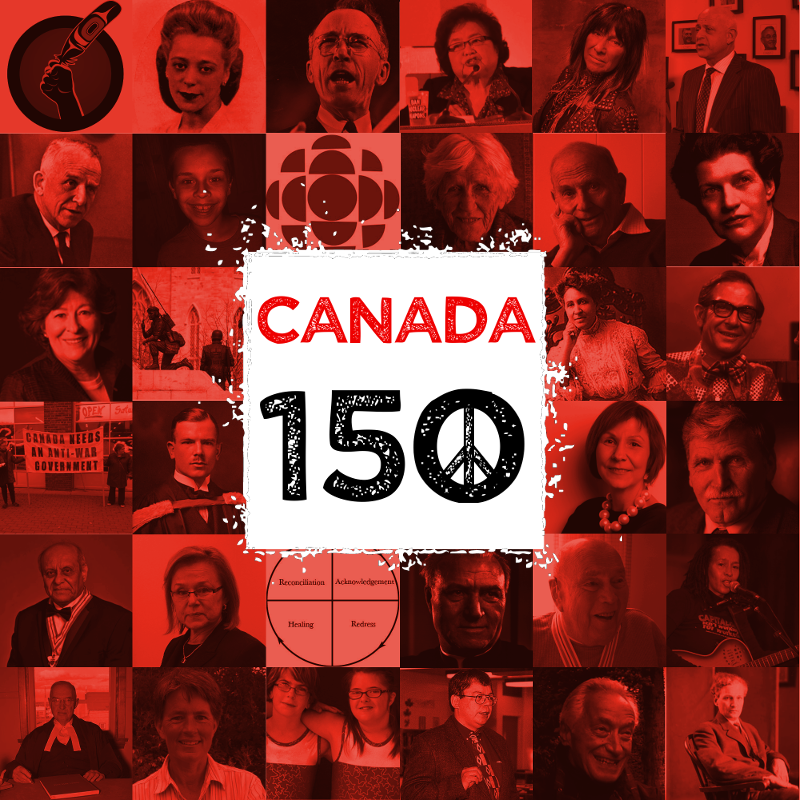
As a diverse group of Canadians from every origin and walk of life, PeaceQuest members have been inspired by this historic moment to recognize the last 150 years of nation building. As much as this is surely a time to celebrate, it is also an occasion for conversation and introspection. What have been our aspirations as a nation? How are these hopes informed by our rich indigenous history which well pre-dates 1867? Is there a shared vision for the future?
PeaceQuest proposes that central to these celebrations and conversations around our national identity, the core value of peace enjoys an important and prominent place.
Follow us to stay on top of the names as they are announced!
The Canada 150 initiative will, for 150 days from February 2 to July 1, 2017, highlight a person, organization, event or artifact that has contributed to peace in our communities, our nation or, indeed, in our world. Through various social media, PeaceQuest will post these contributions daily so that we can all learn more about Canadian efforts, both historic and contemporary, to promote peace as a core Canadian value.
What do you mean by a contribution to peace?
This is an important question. Just as PeaceQuest has hesitated to offer a strict definition of peace, suggesting instead a description of peace (Peace is an active way of living, seeking to resolve conflicts cooperatively, respecting the wellbeing of the earth and all peoples.), so we wanted to leave this notion as broad as possible. We understand such contributions to exist across a spectrum, from explicit efforts to end violence, to initiatives that address the causes of violence, to more general work to advance and defend basic human dignity.
Who’s to say that PeaceQuest’s 150 selections are the right choices?
Good question. It’s not so much about getting it right, but more about fostering a broad conversation about peace. We anticipate that there will be some names that will surprise you, either by their presence or their absence. But that’s where Canadians can get involved and make this a national conversation. We need to hear other voices, your voice.
How can I participate?
There are two ways in which you can get involved:
1. offer your own feedback on what we post in the comments section below.
2. send us your own ideas by completing the following statement on the Contact Us page.
” _____________ , (insert name of a person, organization, event, artifact) contributed to peace by _________________________.”
In the first blank, identify a person, organization, event or artifact (it already may be well known across the county or, in your estimation, someone/thing that should be better known by Canadians). In the second blank, briefly describe how this person/organization/ event/artifact has helped to foster peace (in your community; across our nation; globally).
Is that all there is to it?
No, there is actually more. By following the links provided, you will be able to find more information on our web page about the item listed. Beyond that, it’s up to you to dig deeper.
And where you have offered your own contribution, why not consider including a more complete description of how this person/organization/ event/artifact contributed to our national character in terms of peace? If you have a suitable photo or graphic, we would love to see that, too.
Won’t there be more than 150 items if many others get involved?
We sure hope so … and PeaceQuest will continue to post and moderate this conversation up to the end of 2017.
Together, let us celebrate those who have insured that peace remains a core Canadian value lying at the heart of our collective Canadian identity.