150+ Historians Day 34: Historians

Historians like Margaret MacMillan, Desmond Morton, Arthur Manuel contributed to peace by making our shared histories more accessible. #Canada150

Margaret Olwen MacMillan (b. 23 December 1943) is a Canadian historian and professor at the University of Oxford, where she is Warden of St Antony’s College. A leading expert on history and international relations, MacMillan is a commentator in the media.  Desmond Dillon Paul Morton is a Canadian historian who specializes in the history of the Canadian military, as well as the history of Canadian political and industrial relations.  Peter Brock, Professor Emeritus of History, University of Toronto (d. May 28, 2006) was a Quaker and conscientious objector in Britain during World War II. He was fluent in many languages and the author of 30 books and numerous articles, several about Doukhobors

Her most successful work is Peacemakers: The Paris Peace Conference of 1919 and Its Attempt to End War, also published as Paris 1919: Six Months That Changed the World. Peacemakers won the Duff Cooper Prize for outstanding literary work in the field of history, biography or politics; the Hessell-Tiltman Prize for History; the prestigious Samuel Johnson Prize for the best work of non-fiction published in the United Kingdom and the 2003 Governor General’s Literary Award in Canada. MacMillan has served on the boards of the Canadian Institute for International Affairs, the Atlantic Council of Canada, the Ontario Heritage Foundation, Historica and the Churchill Society for the Advancement of Parliamentary Democracy (Canada). She is a Fellow of the Royal Society of Literature, an Honorary Fellow of St Antony’s College, Oxford and a Senior Fellow of Massey College, University of Toronto. She has honorary degrees from the University of King’s College, the Royal Military College of Canada and Ryerson University, Toronto. She was made an Officer of the Order of Canada in February 2006 which was later upgraded to Companion of the Order of Canada on December 30, 2015.


Desmond Dillon Paul Morton is a Canadian historian who specializes in the history of the Canadian military, as well as the history of Canadian political and industrial relations. He is a graduate of the Collège militaire royal de St-Jean, the Royal Military College of Canada, a Rhodes Scholar, the University of Oxford (where he received his PhD), and the London School of Economics. He spent ten years in the Canadian Army (1954–1964 retiring as a Captain) prior to beginning his teaching career.[1] He was named Honorary Colonel of 8 Wing of the Canadian Air Force at CFB Trenton in 2002. He received the Canadian Forces Decoration in 2004 for 12 years total military service.[1]

He is the author of over thirty-five books on Canada, including the popular A Short History of Canada. Morton has addressed the issue of whether the First World War was indeed a war of independence of Canada. In 1996, he was made an Officer of the Order of Canada. He has been a Fellow of the Royal Society of Canada since 1985. He once wrote:

“For Canadians, Vimy Ridge was a nation building experience. For some, then and later, it symbolized the fact that the Great War was also Canada’s war of independence”.

In 2008, however, he published the following remarks: “Canadians are now being told by their government and its friends that we achieved the same joyous state on a snowy April 9, 1917, when four Canadian divisions advanced to capture Vimy Ridge at a cost of about 10,000 dead and wounded – enough to bring on a nationally divisive crisis as the English-Canadian majority tried to conscript the French-speaking minority for a war Quebec had never embraced. This may be Stephen Harper’s version of history, learned in the schools of Ontario. But that would be selling ourselves short.” Morton states that the abandonment of Canada by British troops in 1871 was a much more important event in the emergence of Canada as a separate nationality.


Arthur Manuel (d. January 2017) was a historian who entered the field out of the necessity to better document Indigenous histories of the near past. He first entered the world of Indigenous politics in the 1970s, as president of the Native Youth Association. He went on to serve as chief of the Neskonlith Indian Band near Chase, B.C., and elected chair of the Shuswap Nation Tribal Council.

Manuel was the author of Unsettling Canada: A National Wake Up Call, Between the Lines which he co-wrote with Grand Chief Ron Derrickson and was also known internationally, having advocated for Indigenous rights and struggles at the United Nations, The Hague and the World Trade Organization.

Unsettling Canada tells a captivating narrative of activism, identity, and lived experience, tracing Indigenous rights and land claims struggles in this country between the 1960s and 2000s. The book makes an important contribution on this understudied period through everything from the internal debates within the grassroots movement for equity and sovereignty, to how leaders balance the pressures of activism and family life. The book is considered to be highly accessible, with a wide reach in scope as it demonstrates the impact of Indigenous people from Canada had on the global stage and in global activists’ strategies. The book is grounded in Indigenous intellectual traditions and perspectives, and carries the timely message about how bringing justice to Indigenous peoples will also create a more sustainable Canada.

For much of his life, he was active in the Assembly of First Nations and more recently was a spokesman for Defenders of the Land, an organization dedicated to environmental justice.

Continue Reading

150+ Canadians Day 33: Douglas Roche

Douglas Roche contributed to peace by his articulate and consistent call for disarmament.#Canada150

Author, parliamentarian and diplomat, The Hon. Douglas Roche, O.C. was appointed to the Senate of Canada September 17, 1998. Senator Roche was Canada’s Ambassador for Disarmament from 1984 to 1989. He was elected Chairman of the United Nations Disarmament Committee in 1988.  Senator Roche is an Officer of the Order of Canada, Chairman of Canadian Pugwash and Chairman, Middle Powers Initiative, a network of nine international non-governmental organizations specializing in nuclear disarmament.

In 1992, he was given the Thakore Foundation Award “in recognition of his prolonged and distinguished work towards disarmament, global peace and peace education.”  He received in 1993 and again in 1997 the Mahatma Gandhi Foundation for World Peace Award.  In 1995, he received the United Nations Association’s Medal of Honour, and in 2000 the Pomerance Award for work at the United Nations on nuclear disarmament.

In 1995, Pope John Paul II presented him with the Papal Medal for his service as Special Adviser on disarmament and security matters.

His latest book, Peacemakers: How People Around the World Are Building a World Free of War, was released in 2014.

“Extending social and economic development throughout the world and eliminating nuclear weapons from military arsenals are two fundamental prerequisites to replacing the culture of war with a culture of peace, and building true security for all the world’s people.”

Got a name in mind? Contribute to the list! Send us your suggested names on the Contact Us page.

Want to get 150+ Canadians straight to your inbox? Subscribe here.

Continue Reading

150+ Canadians Day 32: Abolition of the Dealth Penalty

Image Credit: Amnesty International.

The abolition of the Death Penalty recognized that execution is inappropriate, irrevocable, and often committed in error. #Canada150

Capital punishment existed in various forms in Canada until 1998, when the federal government completely abolished the death penalty.

One of the earliest recorded executions in Canada came in 1749 in newly-founded Halifax. A sailor named Peter Cartcel killed a man and was tried before a general court comprised of Halifax’s governor and six councillors. He was quickly found guilty and hanged two days later. The last Judicial hanging in Canada took place at Toronto’s Don Jail in 1962. 

In 1976, the House of Commons abolished the death penalty for civilian crimes by a majority of six votes. In 1998, Canada eliminated the death penalty for military offences as well.

One of the most infamous miscarriages of justice occurred in 1959 when 14 year old Steven Truscott was sentenced to hang for the murder of a school mate.  He was paroled in 1969.  In 2008 Truscott was found to be innocent and awarded $6.5 million in damages.

Since then several more Canadians have been wrongfully convicted of murder, including Donald Marshall Jr., David Milgaard, Guy Paul Morin, William Mullins-Johnson, Romeo Phillion, Thomas Sophonow and Erin Walsh.

Got a name in mind? Contribute to the list! Send us your suggested names on the Contact Us page.

Want to get 150+ Canadians straight to your inbox? Subscribe here.

Continue Reading

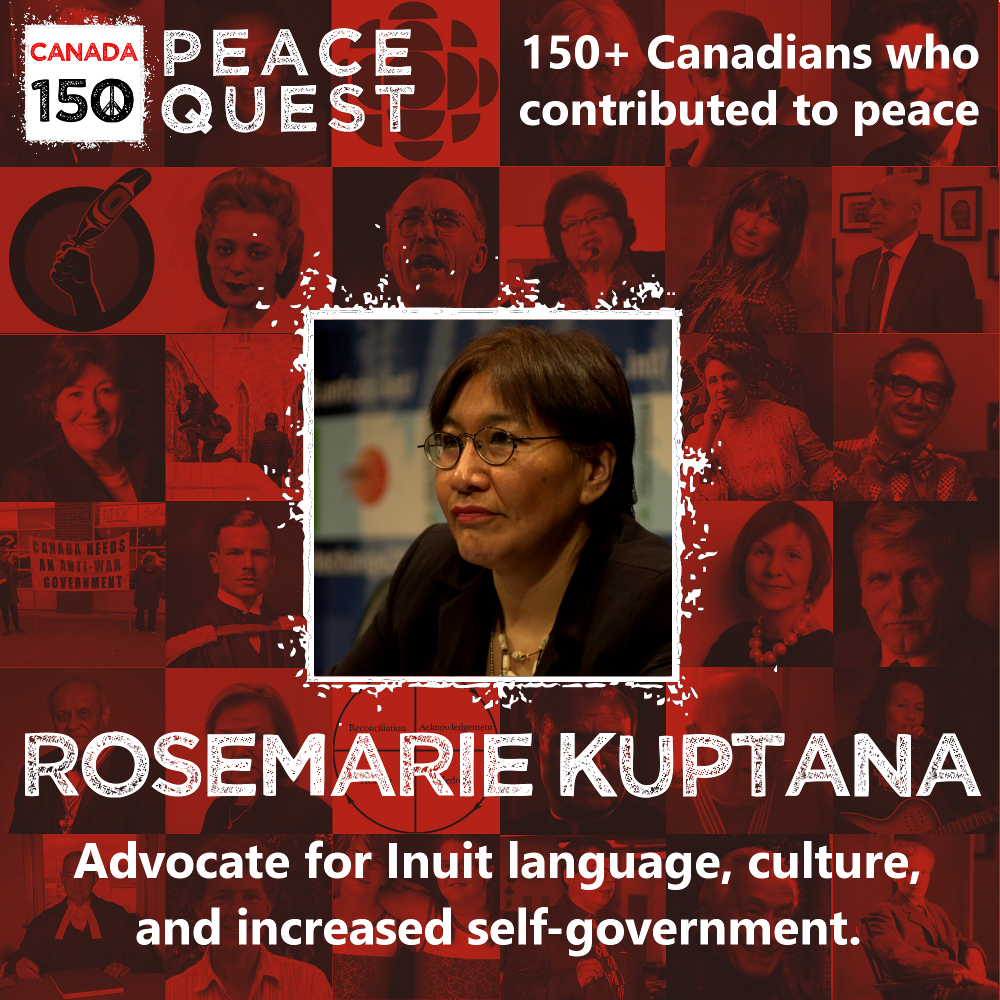
150+ Canadians Day 31: Rosemarie Kuptana

Image Credit: International Institute for Sustainable Development

Rosemarie Kuptana contributed to peace by advocating for the recognition of Inuit self government. #Canada150

Ms. Kuptana has worked for the advancement of Inuit language and culture and has been a tireless leader in the area of human rights since 1975.  From 1983 to 1988, she served as the President of the Inuit Broadcasting Corporation (IBC).  During this time, Ms. Kuptana played a vital role in developing a communications system to express and reflect Inuit culture and society.

She has also represented Inuit in other forms, including serving as co-chair of the International Arctic Council and, from 1986 to 1989, as the Canadian vice-president of the Inuit Circumpolar Conference.

She also researched and published No More Secrets (full text PDF here), an examination of child sexual abuse in Inuit communities for Pautuutit, the national Inuit women’s association.  The work has helped Inuit across Canada better recognize and treat this extremely difficult problem.

In April 1991, Ms. Kuptana was elected to a three-year term as president of Inuit Tapiriit Kanatami (ITK), the national voice of Canada’s 35,000 Inuit.  In addition to its self-government efforts, under the Ms. Kuptana’s leadership, the ITK has participated in research and represented Inuit on Arctic environmental issues, pursued acknowledgement of human rights abuses in the relocation of Inuit to the High Arctic during the 1950s, assisted in the settlement of Inuit land claims and developed educational and other programs for Inuit youth.

Continue Reading

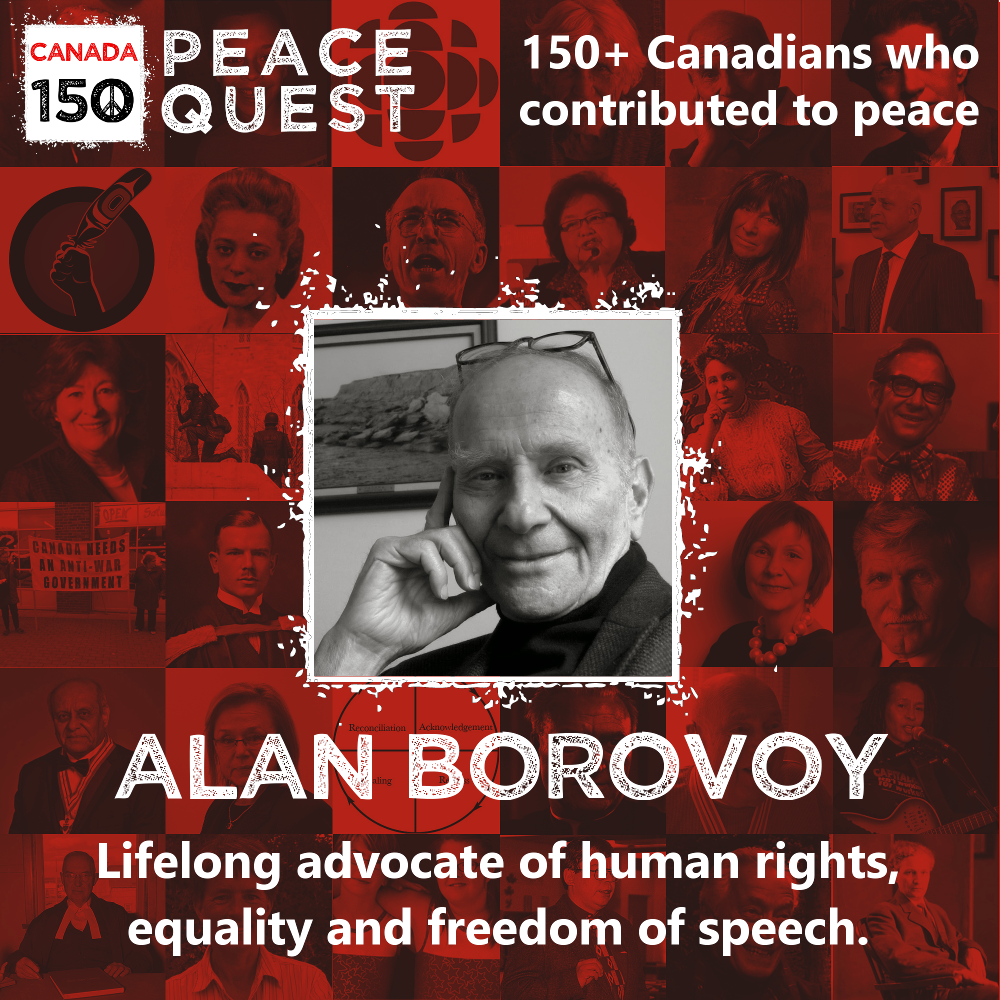
150+ Canadians Day 30: Alan Borovoy

Alan Borovoy contributed to peace by advocating for human rights and against discrimination. #Canada150

In 1960, Alan Borovoy started working as secretary of the Jewish Labour Committee in Toronto fighting racism against minority groups in Toronto, particularly Black Canadians. He was also active with organizations such as the National Committee for Human Rights of the Canadian Labour Congress, the Ontario Labour Committee for Human Rights, and the Toronto & District Labour Committee for Human Rights.

In 1962, he had organized activists in Halifax and attracted a great deal of attention by taking up the cause of the residents of Africville, which led to the formation of the Halifax Advisory Committee on Human Rights. A year later, he was at the centre of a successful campaign to introduce legislation to ban racial discrimination in Ontario. When indigenous communities in Kenora approached Borovoy about discrimination and poor government services in the 1960s, he organized a large protest march to city hall bringing in hundreds from neighbouring reserves to demand everything from telephones to an alcohol treatment centre, which were eventually provided.

Mr. Borovoy was the founder and General Counsel of the Canadian Civil Liberties Association and worked with the Canadian Labour Congress Human Rights Committee and was one of the main contributors to the Canadian and Ontario Human Rights Commission.

 “I would renounce, therefore, the attempt to create heaven on earth, and focus instead on reducing the hell.”

Editor’s bonus material: Following Mr. Borovoy’s passing in 2015, longtime friend, author, and screenwriter George Jonas, offered this story in the National Post which recalls the time when, in 2008, Borovoy defended outspoken right-wing journalist Ezra Levant during the Human Rights Commission freedom of speech controversy.

Continue Reading

150+ Canadians Day 29: Emily Carr

Emily Carr contributed to peace through her iconic landscape art as well as her popularization of indigenous art. #Canada150
“I ornamented my pottery with Indian designs – that was why the tourists bought it. I hated myself for prostituting Indian Art; our Indians did not ‘pot,’ their designs were not intended to ornament clay – but I did keep the Indian design pure.”

Growing Pains – An Autobiography, (Toronto: Irwin Publishing, 1946), 231.

Emily Carr studied in San Francisco from 1889-95, travelled to England in 1899, then lived in France in 1910.  Discouraged by her lack of artistic success, she returned to Victoria where she came close to giving up art altogether.  However, her contact with the Group of Seven in 1930 resurrected her interest in art, and throughout the 1930s she specialized in scenes from the lives and rituals of the indigenous communities she became close with. She also showed her awareness of Canadian Indigenous culture through a number of works representing the British Columbian rainforest. She lived among British Columbia’s First Nations to research her subjects. Many of her Expressionistic paintings represent totem poles and other artifacts of Indigenous culture. She was one of the first artists to attempt to capture the spirit of Canada in a modern style.

She wrote of the importance of preserving indigenous culture and artifacts:

“These things should be to us Canadians what the ancient Briton’s relics are to the English. Only a few more years and they will be gone forever into silent nothingness and I would gather my collection together before they are forever past.”

The Nuu-chah-nulth of Vancouver Island’s west coast had nicknamed Carr Klee Wyck, “the laughing one.” She gave this name to a book about her experiences with the natives, published in 1941. The book won the Governor General’s Award that year. Her other titles were The Book of Small (1942),The House of All Sorts (1944) and Growing Pains (1946) Pause and The Heart of a Peacock (1953), and in 1966, Hundreds and Thousands. They reveal her to be an accomplished writer.

“Look at the earth crowded with growth, new and old bursting from their strong roots hidden in the silent, live ground, each seed according to its own kind…each one knowing what to do, each one demanding its own rights on the earth. So artist, you too from the depths of your soul…let your roots creep forth, gaining strength.”

Bonus Editor’s material: If you, as I, have some thorny questions about Emily’s unique and somewhat ambiguous role in colonization. Do know that our committee chose her (and others) with these ambiguities in full mind. For further readings on this delicate interplay, we suggest this Globe article written by Sarah Milroy, an art gallery curator who struggled with these same questions.

Continue Reading

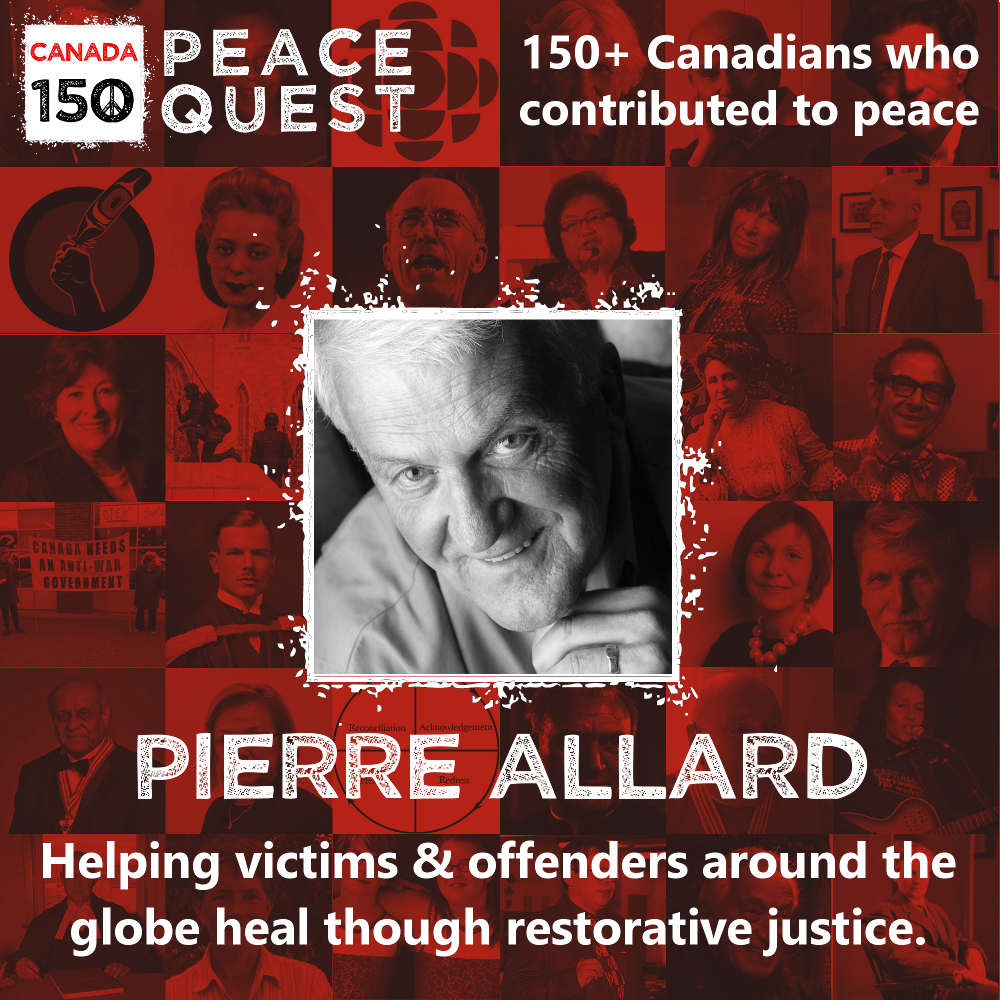
150+ Canadians Day 28: Pierre Allard

Image Credit: Centre for Services in Restorative Justice (CSJR)

Pierre Allard contributed to peace by building capacity for victims and offenders heal through restorative justice.#Canada150

Pierre Allard has had a long career in chaplaincy with Correctional Services of Canada. For over a quarter of a century, Rev. Allard has been engaged in the spiritual sustenance of prisoners. His work has placed him at the forefront of the new restorative justice movement, which brings together communities, offenders, and victims of crime to discuss the effects of criminal acts on the community.

A favourite Allard story flows from the birth of their first daughter, Sophia. Shortly after she was born, he and Judith took her to the prison one Sunday for a chapel service. At the service, 50 inmates gathered in a circle, where Judith handed off Sophia to the inmate standing beside her. Then, slowly, the baby was passed from hand to hand, around the dewy-eyed circle. When she was returned to her parents, the chaplain talked to the men about new life and a new start, suggesting that it was available to everyone, even those who are incarcerated.

That event, and the 1980 murder of his brother, Andre, helped to shape his strong belief in restorative justice — the concept that stresses restoration of relationships between offender and victim. He is also a strong supporter of “circles of support and accountability.” This is a program especially applicable to sexual offenders who have completed their sentences. Circles of volunteers, often church-based, figuratively surround the offender, providing social and physical blockages to re-offending. Dr. Allard says the program, about a decade old, is over 90 per cent successful so far.

Pierre is the president of Just Equipping. Just Equipping is a Canadian Registered Charity committed to equipping people in the area of restorative justice. Since 2006, a number of training missions have taken place in Africa: Rwanda, Burundi, RD Congo and Cameroon. Just Equipping can play a crucial role in the reintegration of offenders, the rebuilding of communities, the comfort of victims and the future of corrections and chaplaincy in these countries.

Pierre is also an ambassador for Centre de Services de Justice Réparatrice, or Centre for Services in Restorative Justice. You can learn more about their work on their website.

Bonus Video: Here is Pierre, in his own words, telling the story of his path towards restorative justice.

Continue Reading

Receive 150+ Canadians straight to your Inbox!

After receiving a few requests to this end, we have opted to add an e-mail component to our 150+ Canadians Who Contributed to Peace project. Fill out the form below to subscribe.

Subscribe here for daily updates.

* indicates required


Please note! This is a different list from our monthly e-mail newsletter – so just keep that in mind. If you would ALSO like to subscribe to our monthly newsletter, you can subscribe here.

Continue Reading

150+ Canadians Day 27: Buffy Sainte-Marie

Buffy Sainte-Marie contributes to peace through her artistic and educational activities, advocating for human rights and against war.#Canada150

In 1997 she founded the Cradleboard Teaching Project, an educational curriculum devoted to better understanding Native Americans. She has won recognition and many awards and honours for both her music and her work in education and social activism.

Sainte-Marie has claimed that at one time she had been blacklisted by American radio stations and that she, along with Native Americans and other native people in the Red Power movements, were put out of business in the 1970s.

In a 1999 interview, Sainte-Marie said, “I found out 10 years later, in the 1980s, that President Lyndon B. Johnson had been writing letters on White House stationery praising radio stations for suppressing my music. … In the 1970s, not only was the protest movement put out of business, but the Native American movement was attacked.”  In 2015, Sainte-Marie released the album Power in the Blood on True North Records. She had a television appearance on May 22, 2015 with Democracy Now! to discuss the record and her musical and activist career. On September 21, 2015, Power in the Blood was named the winner of the 2015 Polaris Music Prize

Most recently, Buffy Sainte-Marie took to the studio with Inuit singer Tanya Tagaq for a Polaris Collaboration Session. A studio performance video of “You Got To Run (Spirit Of The Wind)” is available for viewing on the Polaris Music Prize YouTube channel. An interview with Buffy and Tanya discussing the collaboration on the latest episode of the Polaris Podcast.

Continue Reading

150+ Canadians Day 26: Innocence Canada

Innocence Canada contributes to peace by working to exonerate those convicted of crimes they did not commit. #Canada150

The Association in Defense of the Wrongly Convicted, now known as Innocence Canada, was founded in 1993 as a successor organization of the Justice for Guy Paul Morin Committee.  The group has secured the exoneration of twenty wrongfully convicted persons.

The organization works to identify and advocate for the wrongfully convicted and to prevent wrongful convictions through legal education and reform. The majority of  legal work is done by lawyers for free. The organization estimates that, annually, lawyers across the country donate $3.5 million in pro-bono work.

2016 was a challenging year and, for the first time, they were temporarily unable to accept new cases for a few months. We are happy to hear they are now back on track accepting new applicants! You can view a full list of those who have been exonerated as a result of Innocence Canada’s work on their website.

Without Innocence Canada, I would not have had my name cleared.  Innocence Canada is an essential organization that not only provided hope, freedom and emotional support to me and my family but to countless other people convicted of crimes they did not commit.   As long as Innocence Canada exists, there is reassurance that the Charter Rights of Canadian people will not be overlooked.”

Maria Shepherd, who was acquitted on February 29, 2016


Continue Reading